
Spokane County Criminal Court Cases
Spokane County Superior Court is Washington's general-jurisdiction trial court for local felony cases. The Spokane County Clerk keeps that court's filed information, motions, orders, hearing record, judgment, sentence, and legal financial obligation entries. Its criminal category also includes gross misdemeanors filed in Superior Court. Spokane County District Court handles limited-jurisdiction criminal matters, while Spokane Municipal Court and municipal courts serving Airway Heights, Cheney, and Medical Lake keep cases filed under their own authority. The court named in the case number controls where an official document request goes.
The county's Search Spokane Local Courts hub routes readers toward Superior, District, municipal, and statewide search tools. That hub is a starting point, not one combined Spokane County court file. A police report and jail booking may show the charge known at the time of arrest. The prosecutor can file a different charge, and only the court docket shows what was formally alleged and how the Spokane County criminal case ended.
Spokane County Court Jurisdictions
Choosing the right Spokane County criminal court prevents a common dead end. A felony filing points to Superior Court and the County Clerk. Most misdemeanors, gross misdemeanors, traffic crimes, and probable-cause matters lead to District Court or a municipal court. Spokane County District Court also has a Cheney branch. The Washington Courts selector lists each court separately, so a search limited to the wrong court can return nothing even when a criminal case exists elsewhere in the county.
Use the case caption, citation, notice, or full case number to identify the court. If only a name is known, search both Superior Court and the relevant limited-jurisdiction group. The seriousness label helps, but it is not enough by itself because some gross misdemeanor records appear in different court settings. Under RCW 9A.20.021, Class A, B, and C crimes are felonies. District and municipal court files cover many gross misdemeanor and misdemeanor charges. These classes set maximum penalties, not a prediction of the result in one Spokane County case.
Searching Spokane County Case Records
Begin with the official Washington Courts Case Records Search. It separates District and Municipal Courts, Superior Courts, and Appellate Courts. A name search requires first and last name, with middle name optional. A case-number search requires the number. Court, case type, and filing-year choices narrow broad results. Index data generally follows clerk entry by about a day, but Washington Courts warns that the index only points to the complete record maintained by the clerk.
- Select Superior Court or District and Municipal Courts, then choose the Spokane County court most likely to hold the filing.
- Search by full case number when available. Otherwise enter the legal first and last name and add the middle name.
- Choose Criminal for Superior Court, or the fitting criminal, traffic, or probable-cause type for a limited court.
- Open the result and note the case number, status, charges, hearing entries, and disposition rather than relying on one event line.
- Ask the correct clerk for any pleading, order, judgment, or certified copy that the online view does not provide.
| Field label | Type | Required | Options or format |
|---|---|---|---|
| Search mode | Choice | Yes | Name, case number, or business name |
| First name | Text | For name search | Use the legal spelling |
| Last name | Text | For name search | Required with first name |
| Middle name | Text | No | Helps separate similar names |
| Case number | Text | For case search | Enter the complete court number |
| Court and case type | Select | No | Choose Spokane court level and criminal type |
| Year filed in or after | Select | No | Available from 1975 forward |
The official Washington Courts case-search entry page shows where the statewide lookup begins.
The pictured state entry routes a Spokane County searcher to an index; it does not replace a copy certified by the court clerk.
Spokane County Court Viewer
The County Clerk Court Viewer adds a local path for Spokane County Superior Court records. It is most useful after the state index identifies a felony case and its number. An online detail can show the court, filing date, status, parties, charges, counsel, hearings, docket events, disposition, sentence, and legal financial obligation activity when those fields have been entered. Document access still varies. Some pleadings and orders require a direct request to the Spokane County Clerk.
The official County Clerk Court Viewer displays the local search interface used for Spokane County Superior Court case information.
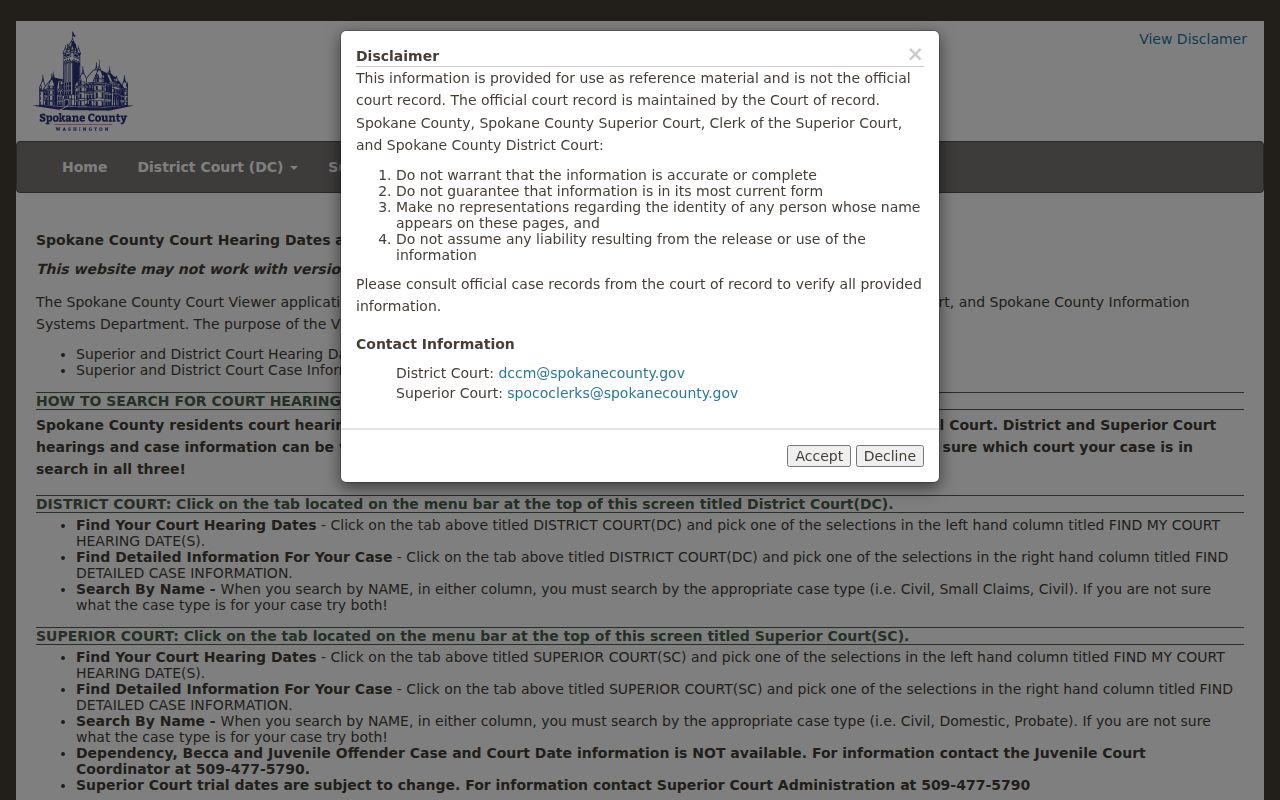
The local viewer is the bridge between a statewide index hit and the Spokane County Clerk, which remains custodian of the official Superior Court file.
Odyssey Portal is another public case-information route for participating Superior Courts. Anonymous users may inspect public case information without registration, but they cannot see documents or restricted cases. Spokane County authorizes registered document access by role. If an online record is absent, do not assume the criminal case was dismissed or sealed. Confirm the court selection and spelling, allow for clerk-entry lag, then contact the correct clerk.
Inside a Spokane County Case File
A Spokane County criminal case file tells the prosecution story after charges are filed. Read the charge document together with later docket entries. An early information or complaint states the allegation then pending, while an amended charge, plea, verdict, dismissal, or judgment can change the outcome. A hearing date shows that an event was set or held. It does not by itself show guilt, dismissal, or the final sentence.
| Case number and court | Identifies the Spokane County filing and the clerk responsible for its documents. |
|---|---|
| Charging document | Shows filed counts, statutes, and the alleged class or seriousness. |
| Parties and counsel | Lists party roles and attorneys when shown in the public record. |
| Docket entries | Tracks filings, motions, continuances, warrants, orders, and other court events. |
| Hearings | May give the date, time, type, room, department, and judicial officer. |
| Plea and disposition | Records the plea and outcome for each filed count when entered. |
| Judgment and sentence | States the court's order, custody or supervision terms, and public LFO activity. |
Birth dates, victim identities, protected addresses, juvenile information, sealed documents, and confidential reports may be removed from public view. A blank field is not proof that the fact does not exist. It may mean the item was not entered, is not part of the public index, or can be reviewed only under the clerk's access rules.
Reading Spokane County Docket Entries
Spokane County publishes several recurring criminal calendars that can make a docket look more final than it is. Superior Court lists legal financial obligation hearings on Wednesdays at 2:30 p.m., probation-violation hearings at 3 p.m., and bench-warrant-recall hearings at 3:30 p.m. Arraignments, motions, Adult Drug Court, and DOSA or FOSA matters also have calendar slots. Schedules may change, so the live calendar controls.
A docket entry for arraignment marks the formal start of the filed case and plea process. A warrant issue or recall records a court action on a warrant. A probation-violation setting concerns compliance after sentence, while an LFO event concerns public financial obligations. None of those entries alone states the result. Look for a disposition by count, judgment and sentence, dismissal order, or later closure entry. The Spokane County Superior Court criminal calendar provides the local schedule context.
Note: A scheduled hearing is a docket event, not a conviction or proof that the hearing produced a final ruling.
How a Criminal Case Moves
A Spokane County criminal court case begins as a court record when the prosecutor files charges, not when police first create an incident or booking record. At arraignment, the filed charge is read and a plea is addressed. Pretrial work can add motions, discovery disputes, continuances, amended charges, and plea talks. A case may then end by plea, dismissal, or trial. The disposition states the outcome, and sentencing records the court's order. Later review can add appeals, LFO entries, warrant recalls, or supervision violations.
Case flow: Charges Filed › Arraignment › Pretrial › Plea or Trial › Disposition › Sentencing
This flow is why one Spokane County case can have many lines without a final result near the top. Read in date order, then verify each count against its disposition. For the earlier custody event, the separate Spokane County Arrest Lookup explains booking and roster records, which should not be treated as the filed court outcome.
Spokane County Specialty Court Records
Specialty programs create ordinary docket events alongside protected treatment material. Spokane County Superior Court names Therapeutic Drug Court, a Co-Occurring Disorders Docket, and Felony Mental Health Court. Defense counsel starts the referral process, and the prosecutor decides referral under published criteria. District Court offers therapeutic court programs as well. Veterans Enhanced Treatment Court serves qualifying limited-jurisdiction defendants under stated eligibility rules, while the Spokane Regional Mental Health Court is a joint District and Spokane Municipal program.
A public Spokane County docket may show referral, program entry, review hearings, conditions, sanctions, graduation, termination, or a later sentence. Assessments, health data, treatment reports, and risk information may remain confidential. The Behavioral Health Adult Felony Therapeutic Courts page identifies the Superior Court programs, and the District Court therapeutic courts index covers the limited-jurisdiction layer.
Case Record Access & Restrictions
Public access to Spokane County criminal court records is governed chiefly by Washington court rules and clerk procedure. General Rule 31 governs public court-record access, while General Rule 15 addresses destruction, sealing, and redaction. Juvenile records follow a separate framework. A sealed file, protected victim data, confidential report, or restricted address may be withheld even when a public index confirms that a case exists.
The Spokane County Clerk accepts Superior Court copy requests at 1116 W Broadway Avenue, Room 300, Spokane, WA 99260, by phone at 509-477-2211, and by mail. Published counter hours are weekdays from 8:30 a.m. to 4 p.m. A mail request should state the case number, party names, and exact documents sought, with a prepaid addressed return envelope and check or money order payable to Spokane County Clerk. The Clerk lists noncertified copies at $0.25 per page. Certified copies cost $5 for the first page plus $1 for each added page of each document.
District Court has separate signed forms for a general defendant or case request, court statistics, and administrative records. Those forms can be mailed to PO Box 2352, Spokane, WA 99210-2352, delivered to 1100 W Mallon Avenue, or faxed to 509-477-6445. Administrative-record requests are not a path to case documents. Municipal records must go to the clerk of the municipal court that filed the matter.
Spokane Federal Criminal Case Records
Federal charges filed in Spokane do not appear in Washington Courts or in a Spokane County Clerk file. The U.S. District Court for the Eastern District of Washington keeps the federal docket. PACER is the official remote system for federal case information and documents. The current schedule charges $0.10 per page, caps many case-document charges at $3, and waives quarterly charges of $30 or less. Some searches, reports, transcripts, and audio follow other fee rules.
The Thomas S. Foley U.S. Courthouse is at 920 W Riverside Avenue, Room 840, Spokane, WA 99201. Its clerk's office number is 509-458-3400, and published weekday hours are 8 a.m. to 5 p.m. Public-terminal inspection may avoid PACER fees. Federal court records are a distinct layer from Spokane County criminal cases, so a thorough search based on known federal involvement must check the federal docket directly.